
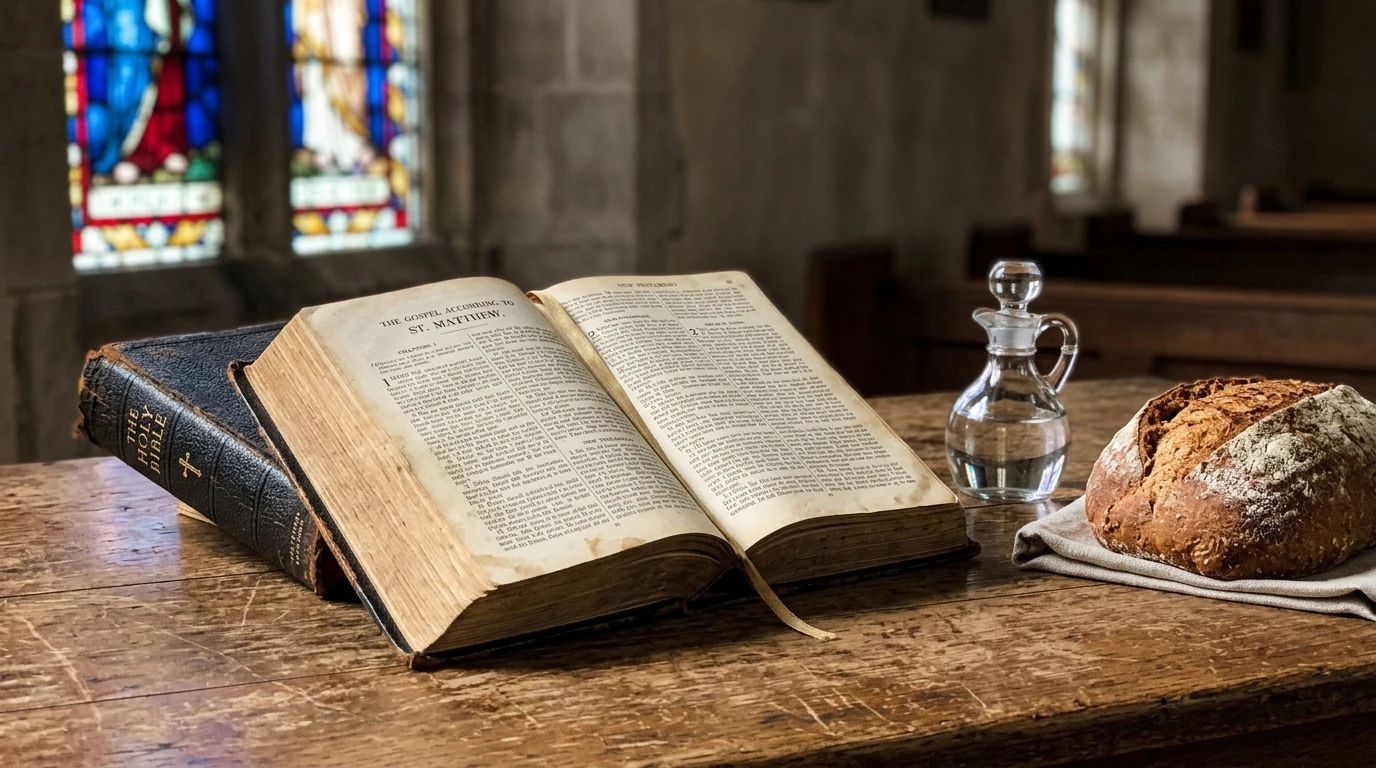
What Does Sacrament Mean in the Bible? Scriptural Roots of Divine Grace
✨ This article was AI edited. Editorial responsibility: Saint Jerome Church.
Produced with AI. This article was artificially generated. Editorial responsibility: Saint Jerome Church.
In the Bible, while the specific Latin term “sacrament” does not appear in original Greek and Hebrew texts, its foundational concept is expressed through the Greek word “mysterion” (sacred mystery), denoting God’s hidden plan of salvation revealed in Jesus Christ and enacted through visible covenantal signs such as baptism, breaking of bread, and laying on of hands.
One of the most frequent questions posed by Christian seekers and Bible students is whether the sacraments are biblical. While modern readers search in vain for the specific English word sacrament in contemporary English translations, the theological reality of sacraments permeates every chapter of Sacred Scripture. From Genesis through Revelation, God consistently utilizes tangible, material creation to convey covenantal promises, impart divine life, and seal communion with His chosen people.
Contents
- From Greek ‘Mysterion’ to Latin ‘Sacramentum’: The Biblical Vocabulary
- Old Testament Prefigurations: The Foreshadowing of Sacramental Signs
- The Seven Sacraments in the New Testament Gospels and Epistles
- Typological Continuity: Old Testament Shadow vs. New Testament Sacramental Reality
- Why the Incarnation Makes Biblical Sacraments Essential
- Frequently Asked Questions About Biblical Sacraments
From Greek ‘Mysterion’ to Latin ‘Sacramentum’: The Biblical Vocabulary
To trace the biblical roots of the sacraments, one must examine the original languages of the New Testament. The Greek noun mysterion occurs twenty-eight times across the New Testament, especially in the epistles of Saint Paul. In Ephesians 1:9 and Colossians 1:26–27, Saint Paul proclaims that the “mystery hidden for ages” has now been made manifest in the flesh of Jesus Christ.
When early Christian scribes translated the Greek New Testament into the Old Latin and later Saint Jerome’s Latin Vulgate in the 4th century, they frequently rendered mysterion as sacramentum. For example, in Ephesians 5:32, speaking of the marital bond between husband and wife as a reflection of Christ and the Church, the Latin Vulgate reads: “Sacramentum hoc magnum est, ego autem dico in Christo et in ecclesia” (“This is a great sacrament [mystery], and I speak concerning Christ and the Church”).
Old Testament Prefigurations: The Foreshadowing of Sacramental Signs
Catholic theology emphasizes typology—the reality that God orchestrated events and institutions in the Old Testament to prefigure and prepare for their spiritual fulfillment in the New Testament. The sacraments did not emerge in a vacuum; they fulfill ancient covenantal prototypes:
- Circumcision as a Type of Baptism: Instituted by God with Abraham (Genesis 17:10–14) as the physical sign of entrance into the covenant, Saint Paul explicitly calls Christian Baptism the “circumcision of Christ” made without hands (Colossians 2:11–12).
- The Passover Lamb and Manna as Types of the Eucharist: The sacrificial lamb whose blood protected the Israelites from death in Egypt (Exodus 12) and the miraculous heavenly manna that sustained them in the desert (Exodus 16) were direct prophetic shadows of Christ, the true Lamb of God, who gives His flesh for the life of the world (John 6:51; 1 Corinthians 5:7).
- The Water from the Rock: When Moses struck the rock at Horeb to give life-saving water to the thirsty Israelites (Exodus 17:6), Saint Paul explains that “the Rock was Christ” (1 Corinthians 10:4), prefiguring the blood and water pouring from Christ’s pierced side upon the Cross.
The Seven Sacraments in the New Testament Gospels and Epistles
Every one of the seven Catholic sacraments is anchored in the explicit words and actions of Jesus Christ and the Apostles recorded in the New Testament:
1. Holy Baptism
Jesus commanded the Apostles: “Go therefore and make disciples of all nations, baptizing them in the name of the Father and of the Son and of the Holy Spirit” (Matthew 28:19). In John 3:5, Christ emphasizes: “Unless one is born of water and the Spirit, he cannot enter the kingdom of God.” In 1 Peter 3:21, the Apostle Peter confirms that “Baptism now saves you.”
2. Holy Confirmation
In Acts 8:14–17, when the Apostles in Jerusalem heard that believers in Samaria had been baptized, they sent Peter and John to lay hands upon them so that they might receive the fullness of the Holy Spirit. Saint Paul repeatedly speaks of believers being “sealed with the promised Holy Spirit” (Ephesians 1:13; 2 Corinthians 1:21–22).
3. The Holy Eucharist
At the Last Supper, Jesus took bread and the cup of wine, blessed them, and declared: “This is my body, which is given for you. Do this in remembrance of me… This cup that is poured out for you is the new covenant in my blood” (Luke 22:19–20). Saint Paul reaffirms the Real Presence in 1 Corinthians 10:16: “The cup of blessing that we bless, is it not a participation in the blood of Christ? The bread that we break, is it not a participation in the body of Christ?”
4. Penance and Reconciliation (Confession)
On the evening of His Resurrection, Jesus breathed upon the Apostles and said: “Receive the Holy Spirit. If you forgive the sins of any, they are forgiven them; if you withhold forgiveness from any, it is withheld” (John 20:22–23). In James 5:16, the Scriptures instruct: “Therefore, confess your sins to one another.”
5. Anointing of the Sick
The Letter of Saint James provides an explicit pastoral blueprint for this sacrament: “Is anyone among you sick? Let him call for the elders [priests] of the church, and let them pray over him, anointing him with oil in the name of the Lord. And the prayer of faith will save the sick man, and the Lord will raise him up; and if he has committed sins, he will be forgiven” (James 5:14–15).
6. Holy Matrimony
Jesus elevated marriage to an indissoluble divine bond, quoting Genesis: “What therefore God has joined together, let not man put asunder” (Matthew 19:6). Saint Paul declares marriage to be a profound reflection of Christ’s sacrificial love for His bride, the Church (Ephesians 5:25–32).
7. Holy Orders
The conferring of ministerial authority through the apostolic succession is described in the Pastoral Epistles: “Do not neglect the gift you have, which was given you by prophecy when the council of elders laid their hands on you” (1 Timothy 4:14; 2 Timothy 1:6; Titus 1:5).
Typological Continuity: Old Testament Shadow vs. New Testament Sacramental Reality
The following table demonstrates how the sacred sacramental economy fulfills biblical typology:
| Sacrament | Old Testament Typological Shadow | New Testament Fulfillment | Biblical Citation |
|---|---|---|---|
| Baptism | Noah’s Ark / Red Sea Crossing / Circumcision | Spiritual regeneration and remission of sin in Christ | 1 Peter 3:20-21; Colossians 2:11-12 |
| Confirmation | Anointing of kings and prophets with holy oil | Apostolic laying on of hands and seal of the Spirit | Acts 8:14-17; 2 Corinthians 1:21-22 |
| Holy Eucharist | Melchizedek’s bread and wine / Passover Lamb / Manna | Real Presence of Christ’s Body and Blood | Genesis 14:18; John 6:48-58; 1 Cor 11:23-26 |
| Reconciliation | Day of Atonement (Yom Kippur) scapegoat | Apostolic authority to bind and loose sins | Leviticus 16; John 20:21-23; Matt 18:18 |
| Anointing of the Sick | Prophetic anointings and healing of Naaman | Presbyteral prayer and oil healing soul and body | 2 Kings 5:10; Mark 6:13; James 5:14-15 |
| Holy Matrimony | Covenant of Adam and Eve in Eden | Sacramental sign of Christ and His Church | Genesis 2:24; Ephesians 5:31-32 |
| Holy Orders | Levitical and Aaronite priesthood | Apostolic laying on of hands and royal priesthood of Christ | Exodus 29; Hebrews 7:17; 2 Timothy 1:6 |
Why the Incarnation Makes Biblical Sacraments Essential
The ultimate theological justification for the sacraments is the Incarnation itself: “And the Word became flesh and dwelt among us” (John 1:14). Christianity is not a disembodied philosophy or a purely psychological mental state. God created the physical universe and proclaimed it good; in Jesus Christ, God entered physical creation.
When Jesus healed the blind man, He spat on the ground and made clay with His saliva (John 9:6). When He fed the multitudes, He used physical loaves and fishes (Matthew 14:19). In the same way, Christ chose water, bread, wine, and consecrated oil as the tangible vehicles through which His eternal salvation reaches human beings in space and time.
Frequently Asked Questions About Biblical Sacraments
Does the word ‘sacrament’ appear in the Bible?
The English word ‘sacrament’ does not appear in English Protestant translations, but its Latin equivalent sacramentum appears repeatedly in the Latin Vulgate to translate the Greek word mysterion (sacred mystery), such as in Ephesians 5:32.
How does the Bible prove that sacraments convey actual grace?
The Scriptures describe physical rites as actively accomplishing spiritual effects: Baptism is said to ‘save you’ (1 Peter 3:21) and ‘wash away sins’ (Acts 22:16); the laying on of hands imparts the Holy Spirit (Acts 8:17); and anointing the sick brings forgiveness and restoration (James 5:15).
What is the difference between a symbol and a biblical sacrament?
A mere symbol points to an absent reality, like a signpost pointing to a distant town. A biblical sacrament is an efficacious sign that actually brings about what it signifies through the power of Christ working within it.
Get our latest guides, news, and insights highlighted in your Google Search & AI Overviews.


 CLASSIFIED INFORMATION ALERT