
Are Churches Catholic? The Surprising Truth About the ‘Universal’ Church
Are Churches Catholic? The Surprising Truth About the ‘Universal’ Church

If you are wondering, “are churches catholic,” the direct answer is no: not all Christian churches are Roman Catholic, but almost all historic Christian denominations consider themselves part of the “catholic” (universal) church. The confusion stems from a single word that has shifted in meaning over two millennia.
Most churchgoers recite creeds affirming their belief in a “holy catholic church” without realizing they are not pledging allegiance to the Pope in Vatican City, but rather to a worldwide, borderless body of believers.
But here is where it gets complicated. What happens when a church formally breaks away from Rome’s authority, or when excommunications alter the landscape of traditionalist groups?
A recent wave of schisms has forced many believers to question what makes a church truly universal. In 2024, the Vatican took unprecedented steps to excommunicate high-profile traditionalist factions, severing them from the institutional church overnight.
Yet, these groups still claim to be the “true” Catholics. The secret to resolving this theological paradox lies hidden in the early centuries of Christianity, and understanding it completely changes how we view denominational divides today.
The defining difference between a legitimate universal church and a splinter sect comes down to one specific historical criterion—which we detail below.
Contents
- Are All Churches Catholic? The Short Answer
- The Meaning of ‘Catholic’ in Early Church History
- Roman Catholic vs. catholic (Small ‘c’): What’s the Difference?
- How to Understand the Four Marks of the Church
- Recent Schisms: What Happens When a Catholic Church is No Longer Catholic?
- Eastern Orthodox and Protestant Perspectives on Catholicity
- Is Christian the Same as Catholic? Key Differences
- Conclusion: Finding Your Place in the Universal Church
- Frequently Asked Questions (FAQ)
Are All Churches Catholic? The Short Answer
To clarify the roman catholic vs catholic distinction, we must look closely at spelling and institutional hierarchy. When capitalized, “Catholic” refers specifically to the Roman Catholic Church, a highly structured institution governed by the papacy and characterized by its seven sacraments and canon law.
When spelled with a lowercase ‘c’, “catholic” simply translates from the Greek word katholikos, meaning universal, general, or all-embracing.
Because of this linguistic overlap, many people inevitably ask: is christian the same as catholic?
The straightforward response is that Catholicism represents the largest single denomination within Christianity. Therefore, all Roman Catholics are Christians, but not all Christians are Roman Catholics.
Protestant, Anglican, and Eastern Orthodox congregations do not submit to papal authority. They possess different governing structures and theological interpretations, yet they firmly believe they belong to the universal, lowercase-c christian church. They view themselves as legitimate members of the global body of Christ.
The Meaning of ‘Catholic’ in Early Church History
The universal church meaning originated long before the modern denominational splits that define today’s religious landscape.
In the early second century, Ignatius of Antioch became the first recorded theologian to use the phrase “catholic church” in his letter to the Smyrnaeans. He used it to describe the entire, unbroken fellowship of Christians scattered across the known world.
At that time, it was a practical tool to distinguish the mainstream, orthodox believers from isolated, localized heretical sects.
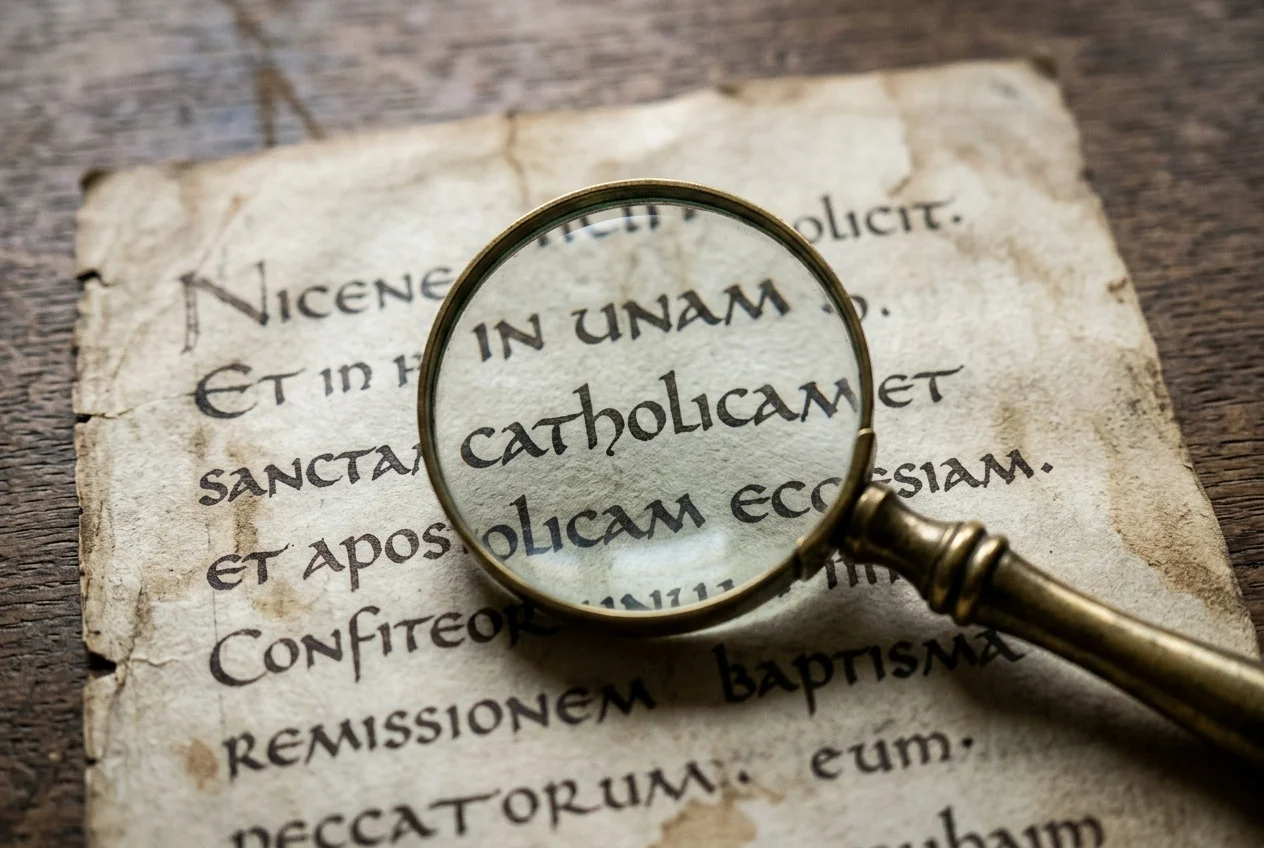
When early Christian councils convened to draft the Apostles’ Creed and the Nicene Creed, they intentionally included a profession of faith in “one holy catholic and apostolic Church.” They were not referring to a specific administrative institution in Rome.
Instead, they meant a global, unified body of Christ that transcended geography, culture, and localized leadership.
Much like historians tracing the historic origins of deep-rooted community traditions and heritage brands, early theologians sought to establish a foundational identity that connected all localized congregations back to the original apostles.
Roman Catholic vs. catholic (Small ‘c’): What’s the Difference?
The distinction between the two definitions became critical after two major historical earthquakes: the Great Schism of 1054 and the Protestant Reformation in the 16th century.
The Roman Catholic Church retained the capitalized title as its formal, exclusive name. This capitalized identity emphasizes a specific hierarchical government, the infallible teaching authority of the Pope, and a strict adherence to canonical law.
Conversely, the lowercase “catholic” evolved into a purely theological descriptor used by non-Roman groups.
A Presbyterian, Methodist, or Lutheran might reject papal supremacy entirely, yet they will stand up on Sunday morning and recite ancient creeds claiming to be part of the catholic church. They do this because they hold to the universal faith handed down through generations.
The capitalized term involves specific, exclusive Catholic traditions—such as transubstantiation, the veneration of saints, and specific liturgical rites—that simply do not apply to the broader, lowercase universal church concept.
How to Understand the Four Marks of the Church
In the Nicene Creed, believers actively profess the four marks of the church: one, holy, catholic, and apostolic. These marks serve as a defining blueprint for orthodox Christianity, though different branches interpret them through vastly different lenses.
“One” signifies a core theological unity in beliefs about Jesus Christ, despite structural divisions. “Holy” indicates that the community of believers is set apart for God’s redemptive purposes in the world.
“Catholic” reinforces the idea of universal reach, meaning the gospel message is applicable to all people in all nations without ethnic or geographic boundaries.
Finally, “apostolic” means the church’s teachings root themselves directly in the instructions given by the original apostles. While Rome interprets “apostolic” as requiring a direct, physical, unbroken line of ordained bishops (known as apostolic succession), Protestant denominations interpret it as remaining faithful to the original apostolic doctrine preserved in Scripture.
Recent Schisms: What Happens When a Catholic Church is No Longer Catholic?
Religious demographics are shifting rapidly globally, and internal conflicts occasionally fracture large, seemingly impenetrable institutions.
When traditionalist splinter groups—such as the Society of Saint Pius X (SSPX) or ultra-conservative monastic orders—defy Vatican directives, they often face immediate excommunication. This raises a fascinating theological dilemma: what practically happens when a recognized Catholic church is formally severed from Rome?
Technically, these breakaway groups maintain their traditional Latin liturgical practices, sacraments, and historical theology. They look, sound, and act entirely Catholic.
However, they instantly lose their canonical standing within the formal Roman Catholic Church. They become independent entities that claim to preserve the “true” Catholic faith, even while operating entirely outside the universal umbrella of papal jurisdiction.
This complex dynamic proves that institutional labels can sometimes mask deep, irreconcilable theological divisions.
Eastern Orthodox and Protestant Perspectives on Catholicity
The Eastern Orthodox Church separated from Rome in 1054, largely over intractable disputes regarding papal authority and specific insertions into creedal wording (the Filioque clause). Today, the Orthodox view themselves as the true, spiritually catholic church.
They maintain that Rome actually departed from the universal faith by adding unbiblical dogmas and centralizing power in one bishop.
Centuries later, during the Protestant Reformation, figures like Martin Luther and John Calvin argued that the institutional church in Rome had become hopelessly corrupt. They initially sought to reform it, not abandon the universal church.
Today, when examining catholic vs protestant differences, the primary divide centers on the source of ultimate authority. Protestants look to Scripture alone (Sola Scriptura) as the final, infallible authority, whereas Catholics rely equally on both written Scripture and sacred church tradition.
Interestingly, the Anglican Communion occupies a unique, hybrid middle ground. Often described by historians as “reformed catholic,” Anglicans maintain highly structured liturgical worship and an episcopal hierarchy, but they operate entirely independently of the Pope.
This demonstrates exactly how fluid and adaptable the concept of catholicity can be across different cultural contexts.
Is Christian the Same as Catholic? Key Differences
To fully grasp the religious landscape, we must return to the foundational question dividing many seekers. Christianity acts as the overarching umbrella covering all believers in Christ.
Underneath that massive umbrella sit three primary branches: Roman Catholicism, Eastern Orthodoxy, and Protestantism.
The differences lie in governance, the approach to the sacraments, and the veneration of Mary and the saints.
A Protestant relies on faith alone for salvation and typically views communion as a symbolic act. A Roman Catholic views the sacraments as necessary channels of grace and believes the communion bread physically transforms into the body of Christ.
Both revere Jesus, but their operational mechanics and theological frameworks operate on completely different frequencies.
Conclusion: Finding Your Place in the Universal Church
Understanding the complex history of these terms removes much of the confusion surrounding modern denominational labels.
Whether a local congregation submits directly to Rome, follows a patriarch in Constantinople, or operates fiercely independently, nearly all orthodox Christian groups share a common theological heritage rooted securely in the early centuries of the faith.
By recognizing the critical difference between a specific geopolitical institution and the broader, global body of believers, you can better appreciate the diverse historic traditions that shape your own community’s worship and identity.
The word “catholic” belongs to every believer who trusts in the universal message of the gospel.
Frequently Asked Questions (FAQ)
Are all churches Catholic?
No, not all Christian churches are Roman Catholic. However, many Protestant and Orthodox churches consider themselves part of the ‘universal’ (catholic with a lower-case ‘c’) Christian church as described in early creeds. Read more about Catholic traditions.
What is the difference between Christian and Catholic?
Catholicism is the largest denomination within Christianity. All Catholics are Christians, but not all Christians are Catholics. Other major branches include Protestantism and Eastern Orthodoxy, which have different views on papal authority.
What does the word ‘catholic’ mean in the Apostles’ Creed?
In the Apostles’ Creed, ‘holy catholic church’ refers to the universal body of all believers in Jesus Christ across the world and throughout history, rather than the Roman Catholic institution. Explore our historic traditions.
Do Protestants believe in the Catholic Church?
Protestants do not submit to the authority of the Pope or the Roman Catholic Church. However, many recite historical creeds affirming belief in the ‘holy catholic church’ in the sense of a universal Christian fellowship.
What happens when a Catholic Church is no longer Catholic?
When a group formally breaks away from Rome’s authority, such as during recent schisms or excommunications of traditionalist splinter groups, they may lose their official standing while still retaining Catholic liturgical practices.
[contact-form-7 id=”1″ title=”Contact form”]
Get our latest guides, news, and insights highlighted in your Google Search & AI Overviews.
 CLASSIFIED INFORMATION ALERT