
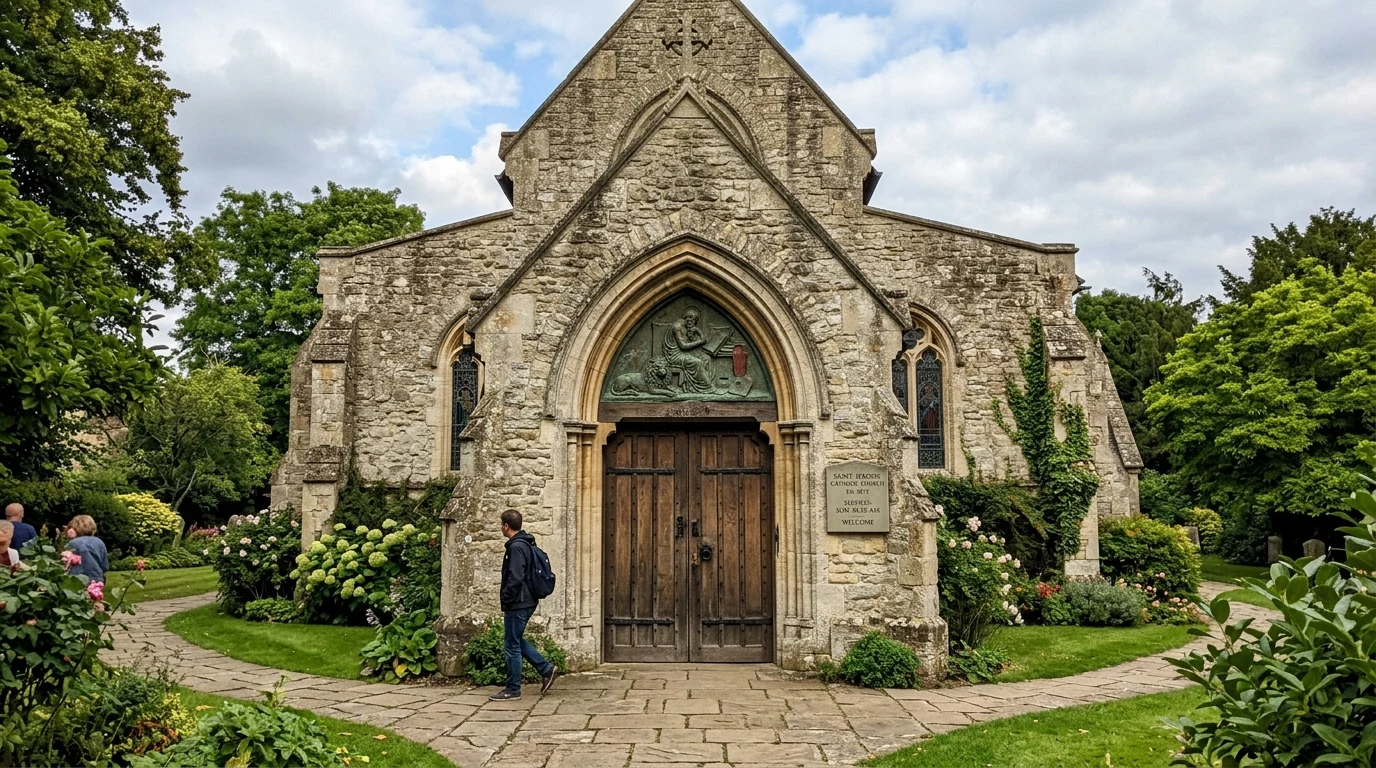
Church of St. Jerome — Sacred Architecture and Liturgical Design
✨ This article was AI edited. Editorial responsibility: Saint Jerome Church.
Produced with AI. This article was artificially generated. Editorial responsibility: Saint Jerome Church.
A Church of St. Jerome is a consecrated Catholic sacred edifice designed for Eucharistic liturgy, communal prayer, and the administration of sacraments under the patronal titular of Saint Jerome. Architecturally, such churches embody traditional Catholic spatial theology, arranging the narthex, nave, and elevated sanctuary to direct the human spirit toward divine contemplation and the real presence of Christ.
Catholic church architecture is never merely functional; it is sacramental architecture where physical matter—stone, marble, wood, glass, and bronze—manifests theological truths. In a church dedicated to Saint Jerome, this architectural harmony uniquely balances ascetic solemnity, scriptural reverence, and the liturgical dignity demanded by Catholic tradition.
Contents
- Theology of Sacred Space: Domus Dei and Domus Ecclesiae
- Architectural Anatomy of a Traditional Catholic Church
- The Focal Center: Altar, Tabernacle, and Sanctuary
- Stained Glass and Visual Catechesis: “The Bible of the Poor”
- Liturgical Orientation and Acoustical Harmony
- Frequently Asked Questions About Catholic Church Architecture
Theology of Sacred Space: Domus Dei and Domus Ecclesiae
In Catholic ecclesiology, a consecrated church building serves two complementary theological functions:
- Domus Ecclesiae (House of the Church): The physical gathering place where the baptized faithful assemble as the Mystical Body of Christ to hear the Word of God and offer collective praise.
- Domus Dei (House of God): The dwelling place of God on earth, made holy by the permanent sacramental reservation of the Most Blessed Sacrament inside the tabernacle.
From the early Christian basilicas of Rome to medieval Romanesque and Gothic cathedrals, church design reflects a progressive movement from the profane outside world into the transcendent holy of holies. As the faithful cross the threshold through the main portals, they enter a consecrated realm oriented toward eternity.
Architectural Anatomy of a Traditional Catholic Church
The following structured reference details the primary architectural divisions, liturgical functions, and symbolic meanings of sacred spaces within a Catholic church:
| Architectural Division | Liturgical Function | Theological Symbolism |
|---|---|---|
| Narthex (Vestibule) | Entryway and gathering foyer before entering the nave | Transition zone between the secular world and sacred space |
| Nave | Main central hall where the congregation gathers for worship | The Barque of Saint Peter (navis) carrying the faithful across the sea of life |
| Sanctuary | Elevated holy area housing the altar, ambo, and tabernacle | Heaven on earth; Mount Calvary and the Upper Room |
| Altar of Sacrifice | Center of the Eucharistic action and memorial of Christ’s passion | Christ Himself, who is Priest, Altar, and Victim |
| Tabernacle | Secure, ornate chest where the consecrated Eucharist is reserved | The New Ark of the Covenant; the Real Presence of Jesus Christ |
| Ambo (Lectern) | Elevated pulpit for the proclamation of the Word of God | The Table of God’s Word, corresponding to the Table of the Eucharist |
| Baptistery / Font | Vessel containing holy water for the sacrament of Baptism | Spiritual womb of Mother Church; rebirth into eternal life |
The Focal Center: Altar, Tabernacle, and Sanctuary
In accordance with the General Instruction of the Roman Missal (GIRM), the sanctuary is elevated above the level of the nave by steps to emphasize its sacred character. Every element within the sanctuary serves a distinct liturgical purpose:
1. The Altar of Sacrifice
The altar is the primary focal point of the entire church. Made preferably of natural stone (symbolizing Christ the “living stone”, 1 Peter 2:4), it represents both the sacrificial altar of Calvary and the festive banquet table of the Last Supper. Consecrated by the bishop with sacred chrism, the altar often encloses holy relics of Christian martyrs within its sepulcher, continuing the ancient Roman catacomb practice of celebrating Mass above the tombs of saints.
2. The Tabernacle and Sanctuary Lamp
Reserved in a prominent, noble, and securely locked tabernacle is the Blessed Sacrament. An adjacent red sanctuary lamp burns continuously with pure wax or oil, signaling to all who enter that Christ is truly and substantially present in the Holy Eucharist (Body, Blood, Soul, and Divinity), calling forth an attitude of silent genuflection and adoration.
3. The Ambo: Proclaiming the Word of God
Particularly resonant in churches dedicated to Saint Jerome, the ambo is treated with high liturgical honor as the “Table of the Word.” From this dedicated lectern, the sacred scriptures are proclaimed during the Liturgy of the Word, the Responsorial Psalm is sung, and the homily is delivered.
Stained Glass and Visual Catechesis: “The Bible of the Poor”
Historically, stained glass windows served as the Biblia Pauperum (Bible of the Poor), visually instructing the illiterate faithful in salvation history through vibrant pictorial narratives. In churches under the patronal care of St. Jerome, stained glass iconography frequently features:
- The Four Evangelists: Matthew (winged man), Mark (winged lion), Luke (winged ox), and John (eagle), highlighting the fourfold Gospel narrative.
- The Western Church Fathers: Saint Jerome alongside Saints Augustine of Hippo, Ambrose of Milan, and Gregory the Great.
- Scenes of Biblical Translation: Jerome studying ancient Hebrew and Greek codices in his Bethlehem hermitage.
- The Mysteries of the Rosary: Depicting the Joyful, Luminous, Sorrowful, and Glorious mysteries of the lives of Jesus and Mary.
Liturgical Orientation and Acoustical Harmony
Traditional church architecture frequently employed ad orientem (eastward) orientation, positioning the altar toward the rising sun as a theological symbol of the resurrected Christ, the “Orient from on high” (Luke 1:78) whose second coming is anticipated from the east.
Furthermore, high vaulted ceilings, stone surfaces, and arched colonnades are engineered to amplify sacred choral music, Gregorian chant, and the resonant tones of the pipe organ, elevating the senses and immersing the assembly in transcendent liturgical worship.
Frequently Asked Questions About Catholic Church Architecture
Why is the altar elevated above the congregation in a Catholic church?
The altar is elevated within the sanctuary to emphasize its role as Mount Calvary and to ensure that all members of the assembly can clearly view and participate in the sacred Eucharistic liturgy.
What does the red candle burning next to the tabernacle mean?
The red sanctuary lamp indicates the active presence of the consecrated Blessed Sacrament (the Real Presence of Jesus Christ) reserved inside the tabernacle.
Why do Catholics genuflect when entering a church?
Catholics bend the right knee to the ground toward the tabernacle as an act of profound adoration and humility before the Real Presence of Jesus Christ in the Eucharist.
The term nave comes from the Latin word navis, meaning “ship,” symbolizing the Church as the ship of salvation carrying believers safely across the stormy waters of the world.
Get our latest guides, news, and insights highlighted in your Google Search & AI Overviews.


 PROSPERITY PRAYER